


Suicide Bombing Kills 41 at Iraq Soccer Stadium
- by Stuart Goldman
- March 2016
A suicide bombing at a soccer stadium in Iraq killed 41 and injured 105 last Friday, according to multiple reports.
The Islamic State, or ISIS, has claimed responsibility in the bombing, which took place at a small stadium in the city of Iskanderiyah, about 25 miles south of the capital of Baghdad.
According to a report, one official said 17 of those killed were boys between the ages of 10 to 16.
Gianni Infantino, who was recently elected the new president of FIFA, said he was “shocked and terribly saddened” and offered his condolences to those killed in the attack.
“Around the world, football unites people,” Infantino said in a statement. “It is a very sad day, when people, going to a match together, become the victims of such violence.”
U.N. Secretary-General Ban Ki-moon also offered his condolences on Saturday, adding that “the international community stands with Iraqis in horror and outrage.”
The attack occurred three days after ISIS-claimed bombings in Brussels, Belgium, killed at least 35 and injured more than 300.
http://www.athleticbusiness.com/stadium-arena/suicide-bombing-kills-41-at-iraq-soccer-stadium.html
Fans Thrown From Malfunctioning Escalator After Flyers Game
by Phil Helsel
An escalator sped up after a Philadelphia Flyers game Saturday, sending fans tumbling to the ground in a pile, according to a witness and video that captured the incident.
“We heard the escalator rev up a little bit. It started going faster and faster. People couldn’t get out of the way fast enough,” Meghan McGreevy told NBC News.
No injuries were reported, the company that owns and operates the Wells Fargo Center said. The mishap occurred after the Flyers’ 3-2 win over the Ottawa Senators in Philadelphia, and the escalator was crowded with fans leaving the game, McGreevy said.
A representative for Comcast-Spectacor said the escalator was immediately closed and was not in use when the basketball team the 76ers played later Saturday.
“The comfort and safety of our guests is our number one concern,” Ike Richman, vice president of public relations for Comcast-Spectacor, said in a statement.
“Immediately following today’s game an incident did occur involving one of our escalators. We immediately closed it down to protect our patrons and notified the operator,” Richman said. “We are working with the operator on investigating this incident.”
http://www.nbcnews.com/news/us-news/fans-thrown-malfunctioning-escalator-after-flyers-game-n549831
Lugnuts make change to ballpark with fan safety in mind
James L. Edwards III, Lansing State Journal 1:36 p.m. EDT March 29, 2016
There will be a new look to Cooley Law School Stadium next time you go to check out the Lansing Lugnuts, and fan experience and safety are the reasons.
The minor league baseball team is in the process of installing a new safety net behind home plate to protect its supporters from the action on the field. The new net, which is roughly 32 feet tall, will span seven seating sections of the ballpark, from home plate to the edge of each dugout. The previous net protected five sections.
The changes come after Major League Baseball recommended that all nets cover any seats that fall within 70 feet of home plate.
“It’s all about safety,” Lugnuts General Manager Nick Grueser said. “Our ballpark is very intimate, which is nice from a fan perspective, but, also, you have to pay attention. A lot of our fans don’t always pay attention to the game — they come for (other) stuff that we do. This really protects them.”
Grueser added that the net is ”more durable and stronger, but not as thick” as the previous one. The goal was to increase fan safety while not taking away from the experience.
“The visibility is better,” Grueser said. “For fans that have always sat behind the net, season ticket holders or anyone that sits back there, we’re actually minimizing the amount of cables that we have.”
The Lugnuts are also in the process of adding three new gates for field access. Those gates have a clear, plexiglass-type surface to them, according to Grueser, to help with visibility as well.
Both of the additions are expected to be completed well before Lansing takes on Michigan State in the Crosstown Showdown on April 6. Opening day for the Lugnuts is April 7.
http://www.lansingstatejournal.com/story/sports/2016/03/29/lugnuts-make-change-ballpark-fan-safety-mind/82379042/
Super Bowl 50: The Most Intense Security at a Sporting Event in U.S. History
A lot of people are going to show up to watch Peyton Manning and Cam Newton square off in the highly anticipated Super Bowl 50. When I say a lot, I mean a lot. Upwards of 75,000 people will be able to buy a ticket to the game and even more will be crowding into Santa Clara restaurants and bars to catch the big game. The immense size of the event coupled with the recent terror attacks on soft targets, including Paris and San Bernardino, California, has made Super Bowl 50 one of the most highly guarded sporting events in U.S. history.
The Super Bowl is considered the second-highest threat environment under U.S. federal guidelines, a notch below what is called a National Security Special Event. That includes summits of world leaders and presidential inaugurations.
Despite the fact that there is currently no specific or credible threat against the Super Bowl, security officials are doing everything possible to ensure that the game goes on without a hitch.
Federal U.S. security officials are tight-lipped about how exactly their plans differ for this year’s NFL championship game from previous Super Bowls, where security is always tight, but hundreds of U.S. law enforcement agents are moving into the Bay Area the week leading up to the game, to be held at Levi’s Stadium. Training events and scenarios have been played through to ensure that all agencies know how to react if the worst comes true.
Security will be tight at the game entrances as well as game-related venues. Fans will be subject to usual metal detectors garnering long lines into the stadium. Only clear bags are allowed inside and items such as banners, camcorders, aerosol cans and umbrellas are strictly prohibited. Bags that are not covered by the guidelines will not be stored at a nearby facility and no plastic bags will be available for at the stadium entrance.
Fans can download the official Super Bowl app for in-stadium content and alert notifications straight to their smartphones. They are also encouraged to follow the twitter accounts: @SuperBowl and @SuperBowl50.
Officials with the Department of Homeland Security will be setting up a giant X-ray machine to screen all cargo allowed into the stadium. Once inside the stadium, cargo and fans will be watched intensely by “VIPR teams” (visible intermodal prevention and response) that include behavior detection officers. These teams will also be deployed at higher populated areas around the stadium, including train stations.
All people throughout the stadium and Bay area will be under heavy surveillance. In one San Francisco neighborhood alone, there are around 3,000 cameras. If you are going to be in the area, expect to have your car, phone and body tracked by officials. It is not clear how the information is accessed or where it is stored, but information sharing with the FBI and other law enforcement agencies is a high priority.
A high-tech command post will serve the efforts of FBI agents, analysts and local law enforcement officers during the festivities. The command post, housed in a nondescript building not far from the stadium, will be overseeing all parts of the game as well as the celebrations before and after.
The FBI will also be deploying commando-style SWAT teams, as well as bomb experts and evidence collection technicians so that specialists are in place should the worst happen. They will have some of their most high-tech gear out and ready to use, such as remote-controlled robots used by the bomb squads.
Federal and local law enforcement agencies issued a bulletin this month, outlining theoretical scenarios, including “lone wolf” attackers like December’s shooting rampage in San Bernardino.
Officials also said that the most vulnerable “targets of opportunity” are outside, not inside the stadium.
While federal officials have confirmed there will be a no fly zone over the stadium, there will be FBI helicopters and planes that will help keep an eye on the ground and because the stadium sits by a creek linked to the Bay, U.S. Coast Guard boats will create a maritime exclusion zone around the game venue.
So, to conclude, Super Bowl 50 is going to be huge and in the wake of many terror attacks that have left numerous innocent people dead, U.S. law enforcement are not going to let up on ensuring this is one of the most heavily guarded sporting events in history.
Posted by Sydny Shepard on Feb 02, 2016
https://securitytoday.com/blogs/reaction/2016/02/super-bowl-50-the-most-intense-security-at-a-sporting-event-in-us-history.aspx
Inside the Super Bowl cyber-ops headquarters
Inside the Super Bowl cyber-ops headquarters
At an undisclosed location in the San Francisco Bay Area, a team of public and private security experts is assembling a pop-up intelligence operations center for Super Bowl 50.
The goal of the multi-agency operation, led by the FBI, is simple: thwart the “bad guys.”
“The Super Bowl is one of the few civilian events that gets to be considered a national security event, so it pulls in the full capability of the U.S. government,” said Rich Mason, president and chief security officer of Critical Infrastructure, a boutique security consulting firm. “They bring a lot of resources into play.”
Others involved include the Department of Homeland Security and U.S. Customs and Borders Protection and state and local agencies
The man coordinating those efforts on the ground is Mike Sena, director of Northern California Regional Intelligence Center (NCRIC).
“I am not sure I will be able to sleep during this whole thing,” he said. “My biggest fear is we are going to have something break or not work. There’s always that Murphy’s law — what can go wrong will go wrong.”
With more than a million NFL fans flooding the Bay Area for the Feb. 7 NFL championship game — against the backdrop of recent global terror attacks — it’s easy to understand Sena’s sentiment.
Virginia-based Haystax Technology — a threat intelligence start-up that counts the state of California, the Department of Defense and DHS among its customers — is helping NCRIC map and make sense of all the data flowing into the intelligence operations center.
The company specializes in cybersecurity around live events and has helped keep safe a slew of high profile gatherings, including the Republican National Convention, the Oscars, the Indy 500 and six prior Super Bowls.
This year, things are a little different.
“This one in particular has a little bit more of a threat intelligence lens on it,” said Bryan Ware, Haystax Technology’s chief technology officer. “What I am seeing a lot of this year that I can’t recall seeing quite as much of is really the planning and the thought and the analysis around potential threat scenarios.”
Haystax licenses its California Common Operating Picture for Threat Awareness (Cal COP) software to a coalition of California agencies, and the Super Bowl partnership builds on that existing relationship, said Ware. The platform aggregates information — which could be in the form of officer field report or traffic incident data — then disseminates it to public safety officials.
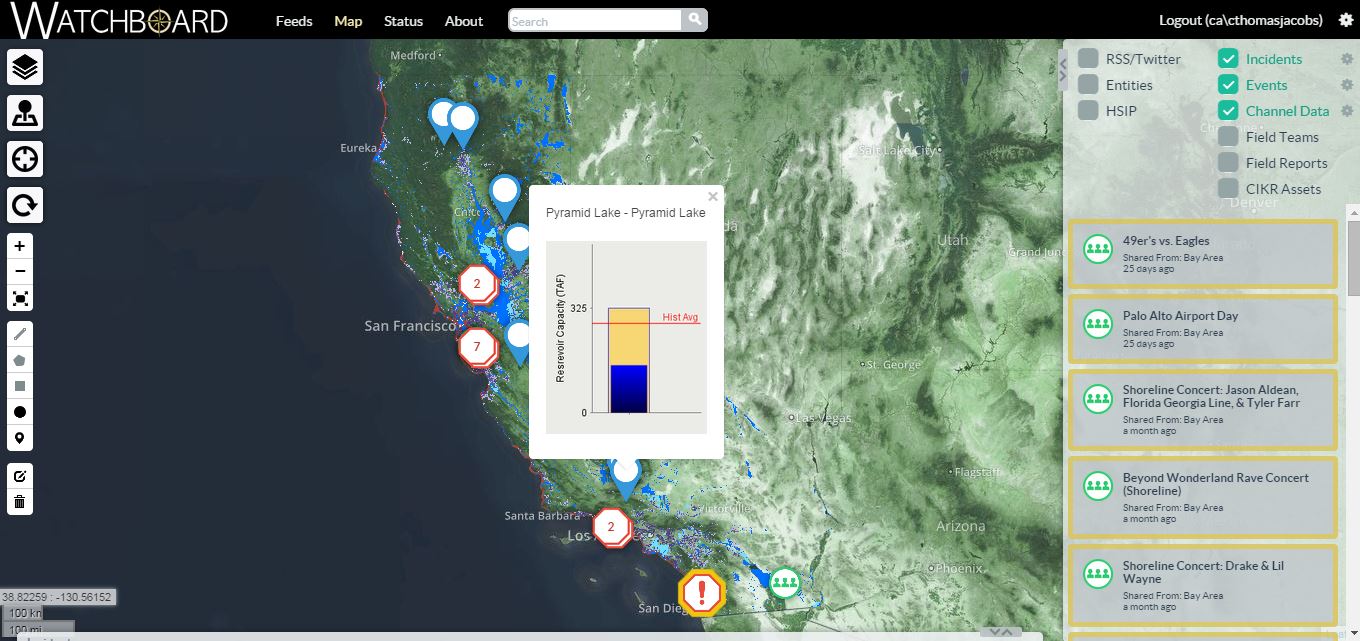
“There is increasingly so much more data and so many kinds of sensors that could be brought to bear, that it’s really overwhelming,” Ware said. “But at the same time, you want to have the best information and it’s really our software that sits at the core and providing that situational awareness to the incident commanders and various security and law enforcement personnel.”
A giant dashboard Haystax calls “Watchboard” displays all that data on a map at the intelligence operations center. A backup operations center will also run around the clock at Haystax’s McLean, Virginia, headquarters. The company’s software also feeds data into the Cal COP app.
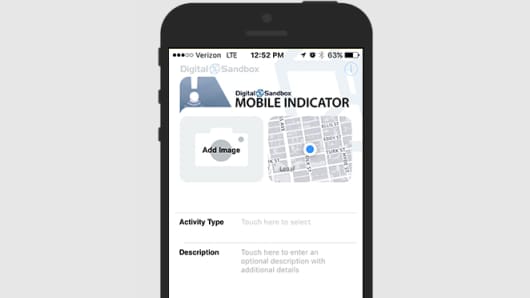
“Having the ability to use applications — where you can literally take a quick note or a snapshot and say this is the situation here right now — clears up those radio channels and allows people to feel more freely about reporting things that they may otherwise not have reported until things escalate,” said Sena.
NCRIC is also running a public awareness campaign around the Bay Area, encouraging people to report suspicious activity, by calling in or visiting the website which has been optimized for mobile.
“If it is evaluated to have a potential nexus to terrorism or criminal activity, it gives them the ability to push that data into the Haystax system so more than one person can see it,” he said.
http://www.cnbc.com/2016/01/28/inside-the-cyber-ops-super-bowl-headquarters.html
MLB recommends clubs extend netting in effort to improve fan safety
Commissioner Rob Manfred has indicated in the past that he would look into new procedures to ensure fans feel safe at the park, and he rolled out some new recommendations concerning fan safety Wednesday. The main focus of that message involved Manfred encouraging clubs to add more protective netting at their parks.
Here is the relevant passage from the press release:
Clubs are encouraged to implement or maintain netting (or another effective protective screen or barrier of their choosing) that shields from line-drive foul balls all field-level seats that are located between the near ends of both dugouts (i.e., the ends of the dugouts located closest to home plate, inclusive of any adjacent camera wells) and within 70 feet of home plate. The Commissioner’s Office has retained a consultant specializing in stadium architecture and protective netting to assist interested Clubs in implementing this recommendation.
On top of that, Manfred has recommended each club continues to find new ways to educate fans about the dangers of flying bats and balls, and will provide teams with resources to assist in this development. He would also like teams to make it more clear which seats will and won’t be behind protective netting during the online ticket buying process.
All three directives are a step in the right direction, but it’s fair to wonder whether Manfred and MLB went far enough. Manfred has the power to make every team implement these new measures, but instead decided making recommendations was the best option.
In fairness, a couple teams have already come out and said they will put Manfred’s suggestions into effect.
As our own Jeff Passan notes, he expects most, if not all, of the teams to follow suit soon. Shortly after MLB made the recommendations public, the Tampa Bay Rays and Boston Red Sox also announced they would comply.
Fan safety is clearly an important issue, and teams probably don’t want to go against the commissioner. Manfred is calling it a “recommendation,” but clubs are going to take that more seriously considering he’s the man in charge.
Still, it would be nice to see Manfred assert his full power here. But if all teams ultimately follow his lead, and fans are safer, the main goal will be accomplished. If certain clubs attempt to push back, it will be interesting to see whether Manfred decides to take more serious actions.
http://sports.yahoo.com/blogs/mlb-big-league-stew/mlb-issues-recommendations-to-clubs-regarding-netting-and-fan-safety-173235470.html
Safety Changes and the Fan Experience
IAVM, December 08, 2015
It started with a sign and grew to an act of terrorism. Security protocols and prohibited items lists across the country went under review when a couple of activists decided to send a message to Bank of America at a Carolina Panthers game. Eleven days later, the first ever terrorism attack on a stadium and the equally horrible acts that followed in Paris. Now most venues are looking at the entire scope of their security plans.
The activist group that decided that repelling at a NFL game would be a good idea was very misinformed. No matter the message they were trying to send or how skilled they are at repelling, they still put their lives and others’ lives at risk. It is not my place to speculate on how they pulled this off, but reading current events is what keeps us sharp. This led me to look at the prohibited items lists for stadiums across the country. Nothing I have found to date mentions anything about rope or climbing gear, however most do include that the stadium has the right to prohibit any items they consider a security risk. The one thing that a written policy like this doesn’t include is human error. If we’re honest with ourselves, most of our staff has not seen climbing gear or other unknown items people may try to bring in the future. We can sit here and write page upon page of prohibited items, but what we need to do is train (and constantly re-train) our staff to ask questions or stop guests at the gates if someone has an unusual personal item.
Signs have been a part of all sports from the beginning. Taking away signs isn’t the answer but setting size limits and rules around proper usage is probably the next best thing. Most stadiums and venues already have these policies in place and probably haven’t had any issues. Personally, my experience has come from working at stadiums with an MLS tenant and I like the approach they’ve made. There is the typical wording about obstructing others’ views/stadium signage, attaching signs to poles, attaching signs to stadium walls/rails, and what type of material a sign is made of. However, most teams have a supporters section where designated members can get access to the stadium before gates open to attach banners to stadium property, set up flags on poles to wave, and use extra noise makers (ex: drums). In addition, these items live at the stadium and are brought in and out of storage by stadium staff before and after each game to avoid any confusion at the entry gates.
Tragedy is an understatement for what happened in Paris, and we need to learn from it. Stade de France faced three suicide bombers and none of them made it past the entry gates. I’m not sure if any or all three actually attempted to enter, but I would like to think that the stadium’s security saved hundreds, or maybe thousands, of lives. On the other hand, at the Bataclan reports stated that 89 lives were lost during the terrorist attacks. I am unaware of the levels of security at this venue, but this is something we have to prevent. It is interesting to see the different levels of security at various venues, and minimal standards are needed. The NFL has possibly set the bar, with most stadiums incorporating two perimeters, one to help reduce prohibited items at the gates, and then again at the gates themselves. Once you’re at the gate, your bag is checked and you will walk through or be wanded by a metal detector. This is a similar gate process that you will experience at other professional stadiums and arenas. It is important that fans understand why these checkpoints are in place, and their safety is worth any delay entering any venue.
This attack has prompted the National Fraternal Order of Police to file a protest against the NFL to change their policies on off-duty officers’ ability to carry during a game. I can see the argument on each side of the table and understand that now more than ever the point to have more weapons for defense does make sense. Nevertheless, this reminds me of an emergency response training I took through FEMA. In the state of emergency, first responders set up an incident command to evaluate the situation, make tactical decisions, and deploy resources. Life isn’t the movies and a Steven Seagal character will probably not be there to save the day. It is important that anyone with any training helps get who they can to safety, and if able to further aid, report to their station to get further information and deployment.
Implementing changes to prevent either of these breaches of security in the future will have several effects. First, expenses will increase as most venues may need to add staff, equipment, or spend more on training, and second the fan experience will change.
Do the changes your venue makes increase the screening time for each guest?
Does this lead to longer lines at the entrance?
If yes, how do you manage the lines to reduce the amount of guests in one area outside the stadium?
Do we prohibit or encourage off-duty officers to carry firearms?
If yes, what do you do if you catch an officer with a beer in hand?
How do you protect the outside areas of your venue?
What type of information and intelligence can we gather beforehand?
What should the max number of items be for a prohibited items list, knowing how much an average worker/guest can remember?
Do you allow fans to still bring signs to games?
What is the proper amount of time spent to train a staff member?
Is it possible to add lines of protection without adding a cost?
Where do safety and security end and an enjoyable guest experience begin?
These questions and the increased awareness and internal reviews should just be the start of larger conversations that should spread across all venues no matter the size or type of events hosted. A general security plan does not fit all buildings or budgets but the collaboration between ourselves and local law enforcement should be at the forefront of discussions. This is where networking not only helps your career but your current employer. I leave this as an open discussion for all to partake.
http://blog.iavm.org/safety-changes-fan-experience/
University of Houston launches probe into football game security
 By Ruthy Munoz December 6, 2015 8:56 PM
HOUSTON (Reuters) – The University of Houston launched an investigation into how security guards reacted to fans who rushed the field in celebration after the school’s football team won its conference championship game, the university said on Sunday.
Several online videos show security guards striking and tackling fans who were running onto the field after the University of Houston beat Temple University 24-13 in the American Athletic Conference Championship game on Saturday.
“I am alarmed and extremely disappointed by the unprofessional performance and offensive behavior of some of the” security guards, Tillman Ferttida, the chairman of the board at the University of Houston, said in a statement.
Ferttida said the university will investigate to determine whether it will seek criminal charges or civil actions against Contemporary Services Corp, a California company that is contracted to handle security at the school’s football games.
“Any actions by CSC personnel that contradict our training, CSC’s other requirements, or the law, are not condoned by CSC and will not be tolerated,” the company said in a statement, adding that it will conduct its own investigation.
Company officials were not immediately available for comment.
(Editing by Brendan O’Brien and Jonathan Oatis)
http://news.yahoo.com/university-houston-launches-probe-football-game-security-015657837–nfl.html;_ylt=AwrBT4GMQGZWLoEA4VVXNyoA;_ylu=X3oDMTEyMThrbnRpBGNvbG8DYmYxBHBvcwMxBHZ0aWQDQjA5MTNfMQRzZWMDc2M-
Plans for explosions cancel Netherlands-Germany soccer match
‘Serious plans for explosions’ cancel Netherlands-Germany soccer match
By Mark Morgenstein and Jason Hanna, CNN
Updated 5:13 PM ET, Tue November 17, 2015
(CNN)“Serious plans for explosions” forced the evacuation of a stadium in Hannover, Germany, on Tuesday night before a Netherlands-Germany friendly soccer match, the police chief for Germany’s Lower Saxony region told Germany’s public broadcaster NDR.
Chief Volker Kluwe told NDR that authorities “had concrete intelligence that someone wanted to set off an explosive device inside the stadium.” The two tips forced officials to cancel the Netherlands-Germany match about 90 minutes before kickoff.
“We do take this intelligence seriously. That is why we proceeded with this protocol. We did not take this decision lightly, but it was in accordance with the seriousness of the intelligence,” Kluwe said. However, no explosives were found at the stadium, regional Interior Minister Boris Pistorius said at a news conference Tuesday night.
German media outlets Der Spiegel and Bild Zeitung reported the tips came from France’s intelligence agency. The French alerted German federal police to an “Iraqi sleeper cell” with plans to stage an attack. CNN has not independently confirmed the report.
The German national team tweeted that the game had been canceled, and “#DieMannschaft are under police protection and have been escorted to a safe place.”
Authorities asked spectators to go home and not stay outside the stadium in big crowds, Kluwe said.
German Chancellor Angela Merkel and at least three other top government officials had been expected to attend the match, Merkel’s office said.
“The decision when you call off such a match is a very difficult one. We all know what this match meant after Paris,” Reinhard Rauball, the interim president of the German Soccer Association, said.
The incident comes four days after three suicide bombers blew themselves up outside the Stade de France in the Parisian suburb of Saint-Denis during a soccer match between France and Germany. The bombers died in the explosions, as did one bystander. That was one of several terror attacks across the French capital Friday night that killed at least 129 people and wounded hundreds more.
“Because of the events in Paris, we were particularly sensitive and prepared for everything,” Kluwe said. “We have prepared for this kind of scenario. … We will have a heavy presence throughout the night and ensure the safety around the city.”
The soccer stadium wasn’t the only place in Hannover where people were worried about their safety. Hannover police posted on their Facebook page Tuesday night that they were examining a suspicious item in the area of the central train station. After partially evacuating the station, police determined the item was a fake bomb left by a passenger who had fled, according to CNN affiliate ARD. Police say they are evaluating surveillance video to identify the passenger, ARD reported.
France and England went ahead with a friendly soccer match Tuesday night at London’s Wembley Stadium, which was lit up in blue, white and red to honor the visiting squad. Leading up to the game, London police increased their presence around the stadium and at several busy areas, such as transport hubs, across the British capital.
CNN’s Stefan Simons, Steve Almasy, Anna Maja Rappard, Claudia Otto, Tommy Evans, Patrick Sung and Ulrike Dehmel contributed to this report
http://www.cnn.com/2015/11/17/europe/germany-netherlands-soccer-canceled/
Quick thinking may have averted massacre at Paris stadium
AP, By JOHN LEICESTER and SAMUEL PETREQUIN, 11/16/15
SAINT-DENIS, France (AP) — The suicide bombers’ explosive belts, packed with shrapnel, had been designed to kill and maim the crowds at the national stadium.
But while their terrorist associates in the city center of Paris killed 128 people in gun and suicide bomb attacks, the three assailants who blew themselves up outside the Stade de France added just one more body to the overall count of 129.
A combination of solid security at the huge arena, quick thinking in a crisis, modern stadium infrastructure and apparent mistakes in the attackers’ planning appears to have averted a massacre. That suggests the host of next year’s European soccer championships, which are expected to draw millions of fans from far and wide, is as well-equipped as any nation can be against such viciousness.
The stadium, much loved because it was there that the national team won the World Cup in 1998, was the first target hit on Friday night. It was packed with 79,000 people watching France beat Germany at soccer. Had the suicide attackers gotten inside or, failing that, blown up outside among crowds before and after the game, they would have been more murderous and caused even more panic, further overloading Paris hospitals and rescue services scrambling to treat hundreds of casualties with battlefield wounds from the city center.
Instead they exploded outside, during the match, when the stadium surrounds were less crowded. One of the explosions was in a lonely dead-end street 500 meters away. Only the first blast was deadly, killing a bystander. There also were several dozen injuries.
At least one of the attackers tried to get in, despite not having a ticket, but was turned away, said an official who spoke on condition of anonymity because he wasn’t authorized to publicly discuss the complex and fast-evolving investigation.
One police theory is that the attackers never expected to get inside, knowing they likely wouldn’t get past security pat-downs with their suicide vests, and instead planned to detonate as people filed in before kick-off or filed out after France’s 2-0 victory.
But their timing may have been off, officials say. When they triggered their vests — two during the first half of the match, the third at half-time — the bulk of the crowd was safely inside, enjoying itself.
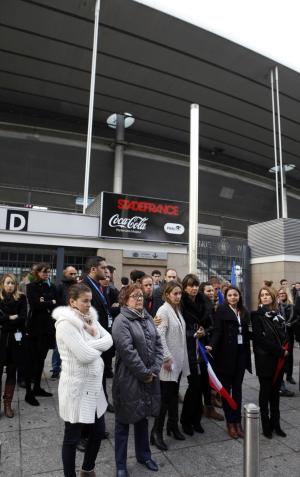
“We think this operation failed,” a police official said, speaking on condition of anonymity because French law doesn’t allow the release of details from ongoing investigations. “Badly organized.”
Still, as chaos unfolded, authorities decided spectators would be safer kept inside and the match went on. That decision was taken by President Francois Hollande, in consultation with French Football Federation officials, the presidential Elysee Palace says.
Bley Bilal Mokono, who arrived late at the game with his 13-year-old son Ryan and a friend, believes he saw one of the attackers — “a man with a beard and a gaunt face” — in the toilets of a restaurant opposite the stadium’s Gate D.
“His face was sweaty, he looked distressed, staring at the mirror in front of him with his hands on the sink,” Mokono told French broadcaster BFM. He saw him again outside, where Mokono had stopped to buy a sandwich. Then came a powerful blast. Mokono was hospitalized with a collarbone injury and damaged hearing.
That first blast, which also killed the bystander, sent shrapnel and flesh whizzing through the restaurant and left a large shattered dent in its frontage of triple-layered toughened glass.
Jeremy, a stadium security guard who would only give his first name for fear of losing his job, said he’d just arrived to help with the aftermath when the second blast went off minutes later, 200 meters (yards) away outside Gate H.
“Everyone was stepping on each other,” he said. “It was a mess.”

The third attacker, for reasons still unknown, waited another 23 minutes to trigger his vest, killing only himself, away from the stadium, next to a tree and a traffic sign in a side-road wedged between office buildings.
The shrapnel shot bullet-like holes in windows and shattered glass in the cab of a parked truck.
Back at the stadium, after the match, truck driver Abdelaziz Boucenna was thrown to the floor and trampled, breaking two fingers and bones in the wrist of his left hand, as people panicked as they were filing out. By then, word of the attacks had spread in the crowd. As Boucenna, his son and nephew neared an exit, they heard people yell, ‘he’s coming, he’s coming!” and imagined it must be an attacker.
“I picked up our kid. I wanted to protect him. We were thrown to the floor. The crowd arrived like a wave. My fingers were all twisted,” Boucenna said.
“The kid’s shocked,” he added. “In his imagination, the guy was carrying a bomb that was about to explode. He thought we were going to die.”
Boucenna’s nephew, Mohammed Chelay, said they were directed to the stadium infirmary. But when shown Boucenna’s fingers, “The woman took a look and said, ‘There’s nothing I can do,” Chelay said.
He added that a riot policeman they also asked for help replied: “‘Listen to me, a bomb exploded 25 meters from me, so I don’t give a (expletive) about your little scratch.”
Another spectator who left the stadium before the end of the match said he ran into chaos outside, with “people hitting the ground and others treading on them. There was a woman sitting on the ground with a head injury and spilling blood.”
He only gave his first name, Said.
Stadium operators and one of the companies in charge of venue security wouldn’t speak to an Associated Press reporter who went Monday to their headquarters. The stadium will host seven matches, including the final, at Euro 2016.
The president of the French Football Federation, Noel Le Graet, said security functioned well.
“Dramatic things happened outside the stadium but inside, the police, stewards and spectators were exemplary,” he told French sports daily L’Equipe. “No crush, no panic. There could have been a veritable catastrophe. That wasn’t the case.”
http://news.yahoo.com/quick-thinking-averted-massacre-paris-attacks-stadium-194442761–spt.html